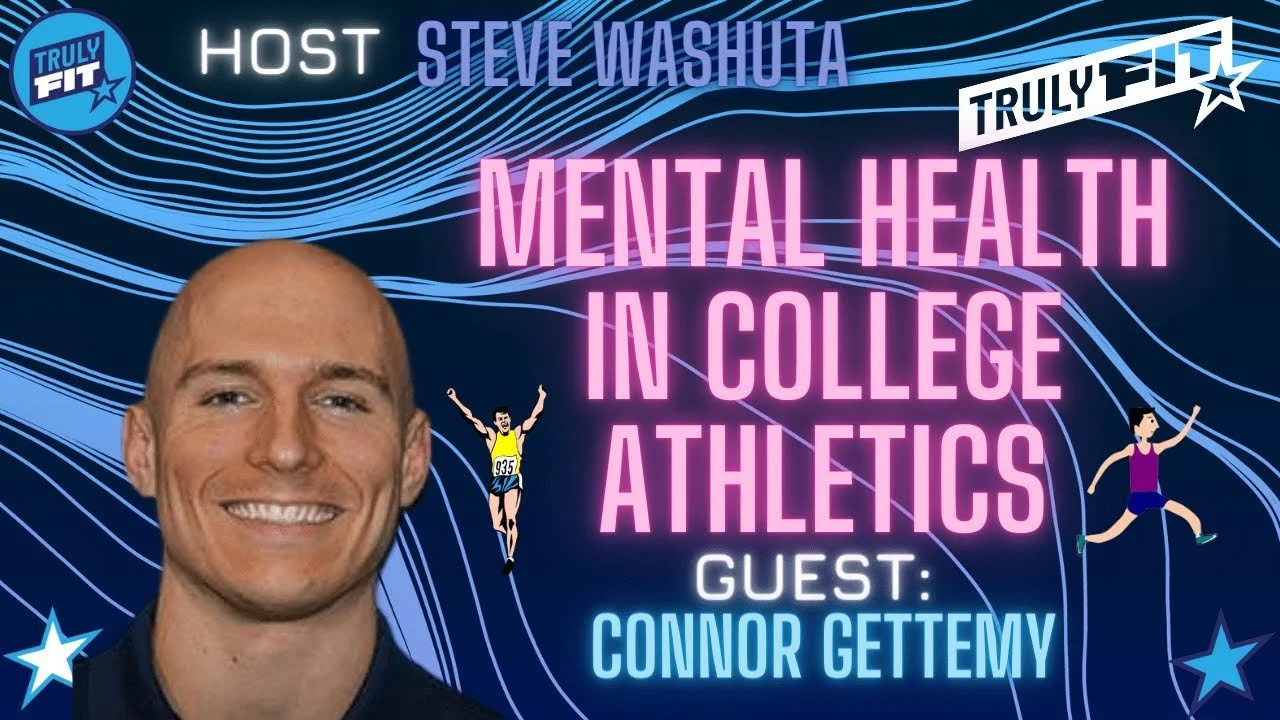
Mental Health in College Athletics
Guest : Connor Gettemy
july 12, 2023
Steve Washuta
What are the offseason training rules for collegiate athletes? Are there more negatives than positives when it comes to the optimization craze? As health and fitness pros? Is it incumbent upon us to care for our clients mental health as much as their physical? We discuss all this and much more in the upcoming episode.
Steve Washuta
Welcome to Trulyfit. Welcome to the Trulyfit podcast where we interview experts in fitness and health to expand our wisdom and well I'm your host Steve Washuta. Co Founder of Trulyfit and author of fitness business one on one.
Steve Washuta
On today's episode I have on Khan Academy. You can find him at Connor co nn o r dot get me GE TT E and y on Instagram. He is a coach. She is the Director of Sports Performance at Flagler College and he has all of the requisite letters for lifting in front of his name is Ma has SCC has CSCs is USA w is pn one, you name it, he's got the certification, Connor and I are going to discuss a little bit of everything we talked about collegiate athletics and mental health, not just physical health of the athletes.
Steve Washuta
We talked about the optimization craze and why we find it to be a little bit ridiculous at times. And we talk about the overall state of health and fitness with our young collegiate athletes what they're going through as far as maybe the differences between now and 20 years ago because of social media. It was a great conversation. Connor always has great insights. You can find everything again about Connor at co nn o r.ge. Tt e m y and instagram with no further ado, here is Connor and I, Connor.
Steve Washuta
Thanks so much for joining the truly fit podcast for round two here. Why don't you give my listeners and audience a little background on who you are and your credentials for those who didn't hear you the first time?
Connor Gettemy
Sure. Good to see you again. Good to be here. My Name Is Khan Academy. I am the Director of Sports Performance at Flagler College that is a division two NCAA institution in St. Augustine, Florida. I've been a college strength and strength conditioning coach for the better part of a decade a little bit under that.
Connor Gettemy
I have an undergrad I got my undergraduate degree in Exercise Exercise Science from Hofstra University that a graduate degree in Sport Management from Waldorf college number of different certs kind of your your standard strength coach certification, so CSCs SCC USA weightlifting, precision nutrition, so just kind of, you know, the requisite letters after my name for people to take me seriously. And that's kind of me in a nutshell.
Steve Washuta
Where are you from originally? from Pittsburgh? Okay. Cool. Like we're like, so I went to school in Morgantown, 70 miles south of Pittsburgh, and I, I spent a lot of time in Pittsburgh whereabouts in Pittsburgh.
Connor Gettemy
Northfield. So I went to North Allegheny. I don't know if you're familiar enough.
Steve Washuta
Yep. Yeah, sir. Yeah, yeah. Cool. So So what's, who you're training right now? What sports are in seasons for your college? And what is the training regimens like right now.
Connor Gettemy
So we are in the summer, so they're, everybody's out of their competitive season? Well, I should say, everybody is out of school, like nobody's in their, you know, their eight hour window as their non competitive season or their 20 hour window as their competitive one. Everybody is out of all of that. And it's just summer training.
Connor Gettemy
So we're we still we're open for any athletes that either live around here full time, or there's they've decided to stay down here. Or they just commute there's some athletes that like live in Jacksonville or Orlando, and they'll just come up and train and and go back home. So it's really whoever just happens to be around.
Connor Gettemy
So this this year, this time around, we had, we've got some volleyball girls, so women's soccer girls, couple of men's soccer guys, some basketball guys. Just kind of a mishmash of whoever happens to be around some women's lacrosse players here and there.
Connor Gettemy
And so in terms of what the training is, if, if we no matter what we'll send every team, a summer training packet, which will cover all of their strength, training, all of their conditioning, all of their speed and agility work. But then, for anybody that is going to be on campus that's going to be training like in our weight room, and I can actually watch them and supervise them.
Connor Gettemy
I write a slightly different program just because I can kind of, you know, I can do some more complicated exercises with them that I wouldn't otherwise trust them to do, let's say Planet Fitness.
Steve Washuta
What is your what is the rules around how much time you're allowed to spend with them? Are you considered a coach? So for example, let me give you a scenario if I was on the women's volleyball team, I would imagine like the NCAA rules around me working with my specific volleyball coach, there's a specific designation on those hours are you included in that because you're a strength training coach?
Connor Gettemy
The Matt Green our our compliance director could probably tell me why I'm wrong here. Hopefully I'm not wrong, but By and large, at least for the general the very general question of like, can I have contact with athletes? The answer is yes.
Connor Gettemy
Okay, simply because any question that somebody might have of, okay, well, what about this, or what about that or the other thing, no matter what I happen to be supervising, if it's an if it's a conditioning session, if it's a speed agility session, if it's a strength strengthening session, or a strength training session, all of it falls under the guise of it's, it's a safety issue, like I have,
Connor Gettemy
if somebody is going to have weight in their hands, they need to be supervised by a professional or somebody who's going to be, you know, conditioning to a point of near, maybe maybe not the right term, but near exhaustion, or, you know, to a, to a very significant degree, or if they're going to be running at, you know, the highest speeds or highest intensities that they can, that they can manage, like all of that, again, falls under a sort of the general umbrella of you need somebody there to supervise that job.
Connor Gettemy
So if you were looking for things that I couldn't do, you know, I will, I'll be as hands off as I can. So I'm not going to, I don't report, hey, this person showed up today, I'm not going to tell any coach, this person showed up on this day this person showed up on this day, I don't take any attendances they track their numbers, but that's just for themselves so that they can just see, okay, I need to progressively overload, I'm not sending those numbers to any coach, essentially, nothing is recorded and sent to anybody that is going to care.
Connor Gettemy
Because for the reasons that I just said, I can't, you know, serve as sort of that conduit between the athlete and the coach, because then I'm essentially acting as, you know, the, hey, this is optional, but it's really mandatory, because coach is going to hear about it.
Steve Washuta
Yeah, that makes perfect sense. You know, from a safety perspective, I don't see why the colleges would care about that, if anything, they should be promoting that. And then also, it's not as if you're giving an advantage that they're not the players aren't working together, they're not talking to the coach, there's no strategic advantage.
Steve Washuta
This is this them benefiting their overall health and wellness, which is less likely to get them injured, hopefully, and I don't see why colleges would ever have a I have a, you know, an issue with that.
Connor Gettemy
Right. And all we do is just say, we just we just post on our, on our public social media. Hey, our, the flybar college sports performance, gymnastic center, or you know, will be open from 9am to 3pm. Monday through Friday, come on in.
Connor Gettemy
So there's no official start time of like, okay, if you're not here by this time, then you're late, like no one's punished for not showing up at a certain time, or anything like that. Like, it's, again, it's, it's, we are around if you need to utilize us, and then that's kind of we'll just operate within that, within those boundaries.
Steve Washuta
Do your athletes and students share a facility or do the athletes have a separate facility
Connor Gettemy
we used to so the facility that I have right now is that used to be the gym for everybody. So my first year on the job for you know 6pm I have 35 baseball players and 15 other like weekend warriors all trying to share for squat racks.
Connor Gettemy
So absolute nightmare our you know, very, very gracious amount of money was spent on providing the non athletic the non athletes students their own fitness center they also in that building that they turned into the fitness center is also serves now as well as the bookstore serves as the male office. And then for us, we didn't have to do any sort of like the rooms already here.
Connor Gettemy
So we just moved into some equipment that was purchased with the budget that we already had or money that we raised. And so we just kind of turned it you know, moved some treadmills out moved some standalone machines out in order to make space for things that are a lot more that are going to be much more useful to meant to a larger number of people quicker in say a 45 minute strength training session that say just a a YMCA type fitness center.
Steve Washuta
Sure, yeah, seems like a must for colleges. Now it's almost a no brainer. I I know that you know, fitness and health is sort of becoming very trend to get younger ages before you know like let's say 20 years ago, it wasn't as trendy. So looking at a recreation center, let's call it fitness rec center basketball courts swimming all of that is very important to 18 year olds when they're going to college.
Steve Washuta
It was even important for me now that's 20 years ago, I remember going to Morgantown looking at their recreation center compared to some other schools and saying this rec center is certainly a poll. So obviously this is what college is going to be doing because it's a it's a huge advantage to pull a student away from a college let's say 20 miles away because your your rec center is better.
Connor Gettemy
For sure and I could be completely off base on this just just based on like my exposure based on social media because because social media isn't real life but what I what i've what I've started to notice is that As opposed to more, just more people in general, finding a good middle ground of let's be generally a little bit more fit, it's kind of separating to either like the more hardcore, not hardcore, but like, people that are super into it, versus people that not just aren't into it, but they're like, here's why this is bad.
Connor Gettemy
Like, here's why, you know, here's why this is promoting diet culture, which is a term that I absolutely hate, or like, you know, here's why. Here's why encouraging people to walk 20 minutes a day is actually whatever term whatever made up term you want to use, like. So again, that's probably just me being on social media too much. But I noticed that it's people either getting super into it, which is terrific, or people actively railing against it.
Steve Washuta
Yeah, I hope I agree with you. That's what I say what I'm hoping is we just don't see the middle ground sort of the centrist because they don't have because they don't have a particular point to push. They're just less likely to be the ones posting, right. So they have accounts, but they're and they're going to the gym, maybe three days a week, just doing standard stuff, doing some machines, doing some bodyweight doing some bench press and some dumbbell lunges.
Steve Washuta
And because they're not dyed in the wool team, don't ever lift, just go for walks, and don't worry about your diet. And then you have the other people who are just like waking up at 4am to like down a shake. And they're, they take pictures in the mirror all day long. So I feel like we are kind of showed those people more often.
Connor Gettemy
What one of the phrases that I've come to absolutely detest is everyone has the same 24 hours, that you know, they don't, they'd like, like, and that's used as like, like, somebody might expect a person like me, who cares about and cares a great deal about their physique and their levels of strength and their fitness and this that the other thing like one, somebody might expect me to be the type of guy that says, everyone has the same 24 hours, you just got to manage your time.
Connor Gettemy
And if it matters, if it matters, you'll do it. If it doesn't matter, you'll make an excuse like, okay, tell them tell that to a single mom. Like, go go, go, you know what yourself like? It just really bugs me when people say like, say stuff like that, that not that's not to say that like oh, in that case, fitness doesn't matter. Like it matters. And that single mom should still like, find ways to do anything. Like I said a 15 minute walk around the around the whatever around her neighborhood.
Connor Gettemy
Like it's just because everyone doesn't have the same 24 hours doesn't mean that like physiology doesn't still apply to you. It just really annoys me when somebody when if somebody can't achieve a certain level of fitness, the answer that some people come up with is well, clearly that person just doesn't want it bad enough.
Steve Washuta
Yeah. And it's usually the people who are like 25, living at home and not there's nothing wrong with this. And they're taking a they're taking a college credits because they're still trying to finish college. And maybe they're working four hours a day, but they're really they're just lifting two hours a day and on Instagram all day. It's like, listen, everyone's lives are different, not only from an age perspective, you have more responsibilities, typically as you get older, not always but typically.
Steve Washuta
And then, you know, if you potentially have kids, like you said, if you're a single mom, we don't know what people are going through. And that's why you hire fitness and health professionals typically, right? Because there are people who can look they can look at your day. That's what I do. I analyze someone's day, and I don't give them an excuse.
Steve Washuta
Like I have a lot of people come up to me counter and they'll say, What's better to work out what time the morning or night? I go? Are you trying to get out of this? Why are you asked like, why are you asking me this? They're like, Well, I only have time at night. It's like, okay, well, the night night is best. Like that's yeah, what when you have time is best.
Steve Washuta
Like we're doesn't we're not going to optimize somebody's fitness and health who barely works out, right? We're not worried about optimization. We're just worried about like getting you moving at this point.
Connor Gettemy
And I mean, that opens up a whole other can of worms, like the whole optimal thing. Like, you know, I peep I've heard I saw today. Like, literally this morning, I saw a post and a non ironic post that said that bent over barbell rows weren't good for back. Like they're a bad back exercise. And like that, it it wasn't the most outlandish point it was basically that a lot of times, like people spinal erectors, and their posture is gonna fail before their back does.
Connor Gettemy
Fair enough. But the way that they phrased it was like going back to like what we were saying about, like, sort of, like sensationalized stuff and nobody's gonna listen to, you know, like, just vanilla opinions. Like, that's what it's gotten to is that like, that's how dumb the vast majority of like Instagram and social media and just the fitness industry has become,
Connor Gettemy
that it has gone so far around and gotten so utterly over thought and like majoring in the minors and paralysis by analysis and all these other buzzwords that you have people you have educated people, making a very serious post say telling people if you want back muscles don't do body all rows. Like that is asinine.
Steve Washuta
Yeah, part of it is a bigger macro problem, which I've talked about before. In this podcast, there used to be two versions of Connor, there was the Connor who all his friends and family know. And then there's the Connor maybe who's a little bit more professional, and kept. And that's maybe what his students know and what his faculty members now right as colleagues know.
Steve Washuta
And now there's really a third version, not of you necessarily, but of people. It's the version you present yourself to be online. And it's usually some exaggerated version right to somebody, because you because you're not seeing facial cues and mannerisms, because you have the opportunity to maybe just live inside of your own bubble where you're not going to get pushback, you pretend to be some weird or exaggerated version of yourself.
Steve Washuta
So we even see, like you said, very smart people who I like, at one point respected now just nitpicking and being weird online and developing these personalities. And I think it's, it's almost not their fault. It's all of us, the social media world sucks you into that. And I don't think there's a good way to get around it except to recognize it be introspective, and try to distance yourself and know that that's not the real version of you.
Connor Gettemy
Well, yeah, and like, get around it look like, I think part of it is accepting that there's, there's only so much content that exists like, like rows or rows, back muscles or back muscles, there's only so many different ways that there's only so many different ways that you can skin a cat at some point with regards to exercise selection, or hypertrophy training or strength training or whatever.
Connor Gettemy
Like at some point in time, just lift weights. Like like, stop like, you know, there's this big push back on barbell bench press right now, but like it's not good for, for for PEC hypertrophy. And, and again, like the point that's being made is is not a bad one. Like, it's not the greatest exercise for PEC hypertrophy.
Connor Gettemy
But to tell somebody don't bench because it's not good for chest is pants on head ridiculous. So like, if you and I, we, I think we talked about this last time I was on like, if somebody like, if benchpress is somebody's favorite thing to do, then that's a good enough reason for them to do it.
Steve Washuta
Also, you getting up on stage, that's the only reason why the hypertrophy is going to matter. More so than like, if you're just a normal, you know, yeah, if you're a normal person, you want overall strength, and you want to also hit your triceps and your, your, your, your, your anterior delts. And you want to focus on explosion, like there's a million reasons to do barbell bench press outside of just building your chest muscles.
Connor Gettemy
Yeah, like for 99 Point, point 9% of the population that lifts weights, like the phrase because I like it is probably a good enough reason to do it. Yeah. And like that, that drives like optimal people insane. Because like, I do bent over rows. I literally just did barbell bench press today. Yeah. And my goals are PEC hypertrophy, and back hypertrophy. I like barbell rows. I like bench press.
Connor Gettemy
So I'm gonna do them. Yeah. And that's it. I don't care how optimal it is. If I enjoyed my workout. Yeah, and that just apparently, that's just becoming a foreign concept of like, No, you didn't do you know, the line of poll and, and the, this particular subsection of your of these fibers of your pack, like, shut up, dude, just just be quiet, like, go go home.
Steve Washuta
I see that now in a lot of exercises that the trendy exercise and this is an offense to anybody, including Connor if it's just the way you go about it, but the trendy exercise now is like only single arm lat pull downs, like nobody in the gym, does traditional apple downs now and they and and the sort of the, the physiological reason why right, the Kinesiology reason why as they say, if I just have one hand on, I'm getting x, I'm extending that muscle further, right?
Steve Washuta
So I'm going through more range of motion, like, Okay, we could argue whether that's the case or not, but also you're taking more time to do your sets, which means you're gonna do less sets overall, which means you're not getting to the next exercise if you have a duration of time. I mean, is it more optimal? I don't know. But like, to the point where everybody in the gym now is only doing single arm lap pull downs.
Connor Gettemy
Yeah, like, Oh, okay. You have suddenly, like, you tell somebody, Hey, only do single arm back work now. Well, suddenly, you just doubled the length of their workout, and now they can't get through their workout anymore. Yeah, like that's not optimal for them. I don't, I could not care.
Connor Gettemy
Like, I want to go up to these people and be like, I can't tell you in words, how little I care about what you have to say about the line of pull of an exercise or the angle of pollination of muscles. Like those things. I'm not saying those things don't matter. They are they 100% are physiological, real facts and realities.
Connor Gettemy
And for the overwhelming majority of people, it doesn't matter not because not because people are physiological anomalies, but like liking something, is liking something more than something else means you are just going to try harder at doing that thing versus the thing that you'd like least or like like less, and you're going to win Look forward your it's gonna be more likely that you'll look forward to doing that thing more often, and you won't get sick of it quite quite so quickly or ever.
Connor Gettemy
Versus Okay, I'm going to drag myself to the gym and do the stupid single arm pulldown because some 22 year old hopped up on 700 milligrams of caffeine and SARMS told me with nine hours of spare time told me it was a good idea.
Steve Washuta
Yeah, I mean, it's it's adherence is what it is, right? That's the simple term. If, if, if I find out that arugula is, you know, has twice the amount of vitamin D and whatever, some other micronutrient as kale, but I like kale, and I don't like arugula. I'm not going to force myself to eat arugula, because I'm going to quit that diet, because I don't like arugula, right? So it's like, just don't don't worry about the optimization worry about the adherence, what can I get to consistently enough, where it's not an absolute torture torturous?
Steve Washuta
And on the other side of the spectrum, I do think there's something good about here and there torturing yourself, but there's different ways to torture yourself. You can also do the thing you like longer, right? So if whatever that thing is, you can push the weight in that particular exercise that's torturous. It doesn't have to be that the exercise itself is something you dislike.
Connor Gettemy
Yeah. There's, I'm essentially just repeating what you said, like, there's something to be said, for, you know, what, I really don't want to do this. And I'm going to voluntarily make myself do it just for some, you know, sort of intangible principle of, I need to, you know, I'm going to remind myself that I can do difficult things fine. Like that's that Absolutely. There's, there's, there's reason to do that.
Connor Gettemy
Like, that's not that's not an unreasonable or that's not a bad reason at all to do something. So it's not to say that, like your workout, 100% of the time should be sunshine and rainbows. But yeah, like, if I have to choose between optimal, like the most optimal upper body day, and an upper body day that I like, really look forward to doing, I'm going to pick the second 110 times out of 10.
Steve Washuta
You You, you and me both, going back to something we said earlier, we're talking about social media now. And sort of the two ends of the spectrum that we see, I have to imagine that comes into play with your athletes, right? As somebody is at me as a fitness professional. I'm always dealing with my clients from an emotional perspective.
Steve Washuta
So I've had clients come to me sometimes Connor, who go I can't lift today, Steve, I, you know, something happened with my kid or my husband or whatever, I just need to talk and I will talk to them for all 60 minutes, they're paying for the session. I don't care.
Steve Washuta
So tell me about how you see your, your profession and your job with your athletes? And how that sort of those conversations and those difficult, let's say mental health issues with your athletes? Do they come up? Do you expect? are you expected to handle that sort of thing? Do you enjoy handling that sort of thing?
Connor Gettemy
The three quick answers would be yes, they do come up to a degree Yes, I'm expected to handle it. And absolutely, I enjoy handling it. So to a degree I'm expected to handle it. Not so much that like, if somebody has a problem, we're going to send them to you. It's just like you as a functioning adult Anna Anna, person that's good at your job.
Connor Gettemy
And your job involves managing people we expect you to have some degree of, of ability to handle a person that is emotional or not having a great day like you should, you should have enough interpersonal skills that you can navigate through a fair amount of, of surface level bad days, right? Do I does it come up? Yeah, like so. Sometimes it'll come up. Even if they don't want it to, like, sometimes it'll be an athlete that like, just just has a horrible attitude.
Connor Gettemy
And then you know, like, the second or third time they answer you with said horrible attitude, like you asked him about it, or call him out on it or whatever you want to say. And then and then just break down right there. And they're just like, I'm just like it's not, and you realize right away, like, Oh, this isn't about me, like it.
Connor Gettemy
And that's probably an important thing to to, to keep in mind that like 99% of the time. It's if somebody is like, specifically for a strength conditioning coach for a college strength conditioning coach, if somebody is being disrespectful to you, the overwhelming likelihood is they didn't wake up and think to themselves, I'm gonna go mess with my strength coach today.
Connor Gettemy
They're almost certainly dealing with something else. And even if they aren't dealing with something else, so they just decided to be a jerk. Like, you might as well operate under the assumption that they need built up rather than broken down.
Connor Gettemy
Because, you know, worst case scenario like you know, some, I let some person be a jerk to me, and turns out there wasn't a reason that they were being a jerk other than the fact that they're a jerk. Okay, big deal. Versus I thought the worst of somebody they really needed somebody to help them out.
Connor Gettemy
And I made them feel even worse. Yeah, which I've been guilty of and totally done earlier in my career. So I just want to make sure I don't do that. And then, yeah, do I enjoy it? I should say, so yeah, sometimes it'll come out whether they wanted to or not. And then other times like they would athlete would just like, either text me or call me or come to my office and say, like, Hey, can can we talk? And that I make it a point to like, first and foremost, we're strength coaches. So like, we need to be good at at at that job before anything else.
Connor Gettemy
And like I just said, we, I'm perfectly comfortable handling, surface level, bad days, and even some, you know, some deeper stuff, you know, if I have a better a closer relationship with an athlete, maybe like, I've known them since they were a freshman. And now they're 22. Like, and, you know, I was there. I was there, when they in their sophomore year, when they were in the weight room and find and found out their mom died or whatever, and stuff like that.
Connor Gettemy
So like, by the time they get to 22, like, we can have a deeper conversation, then, like, I don't, I don't think I'm offending a mental health professional. When I say I'm, I'm somewhat equipped to, to help help that person. Sure. Still, not not remotely to the degree that anybody educated in that realm would be.
Connor Gettemy
But I don't feel like I'm overstepping my boundaries or not operating or operating outside the scope of my practice by just being an ear for you know, somebody that, that they can just bounce, bounce things off of, or just like, cry in my office for 10 minutes, and I just listened like,
Steve Washuta
sure, especially because they're coming to you, Connor, I think that's an important part about it. Right? So like, you know, mental health professionals aside, if I'm one of your athletes, and I feel comfortable with you. And I need to get this off my chest. It's cathartic for me, and I want to do it with someone I trust.
Steve Washuta
That's an important part. It's not necessarily that you have the right answers. It's just that you're a trusted ear, like you said, to listen, because you you've known that person for five years, and they trust you because they know you have their best health in mind physically. So they also assume that you have their best health in mind mentally.
Steve Washuta
So do you feel like there are different problems with these athletes? Athletes now, especially since we talked about social media than maybe you had when you were in athletics? are they dealing with different things? Or is this just run of the mill stuff, their girlfriends break up with them, they have problems passing grades and math, they have problems with at, you know, at home, things of that nature?
Connor Gettemy
I mean, yeah, up on the surface, like those, all the things that you just mentioned, certainly sound familiar, like, probably 99% of the time, it's, it's stuff like that, like, the I off the top of my head, I really can't think of any anything that's sort of like, you know, truly unique to this, this era, or like this, this generation, that isn't, at the very least the same issue that other people have dealt with just perhaps, and presented in a different way.
Connor Gettemy
So like bullying, just as an example of something that, at least from what I from it, nothing gets to me, maybe it happens, but it's not happening so much that I'm hearing about it. But bullying, just as a general example, happened since the beginning of time, it still happens.
Connor Gettemy
Now. It just happens over the internet, as opposed to in person still happens in person all the time. But like, you know, that's so the light, like cyber bullying would be a quote unquote, new thing. That is still something that has always happened as long as people have been around. It's just now presented in a different wrapper, so to speak.
Connor Gettemy
Sure. So I think I think it's difficult to answer. Is there anything new also, just because I don't think people have, I don't think there's been enough studies, like longitudinal studies done on the effects of social media on people.
Connor Gettemy
There's been plenty that the whole, but pretty much everything ever has suggested that like, Yeah, you should delete all of your social media, because it's hair. It's terrible for you. But I don't know, if anybody's, I probably I'm probably behind the eight ball on this. But like, I'm sure that I don't know if there's been a whole bunch of stuff that where people can say conclusively, it has this, it does this, this and this to your brain.
Connor Gettemy
And we have seen that this thing in particular happens, like there's an increase in generally, there's an increase in some behavioral stuff like anxiety, and depression and suicide and all that. And it's correlated, but I don't know if anyone has been like, here's the exact thing about this app that makes people do this thing. Like, I don't know if it's just it's been distilled down to that specific thing. Yeah.
Steve Washuta
Yeah, I don't think it's causal. I think it's correlative, but it's pretty strong correlation, especially like in women, more so than men. It seems that women are like Jonathan Hite wrote, talked about in his book, The coddling of the American mind where women's suicide rates rise.
Steve Washuta
Since a girl's not really women, from the age of whatever it was, let's say, nine to 17, had like, quadrupled, basically since the inception of Facebook, and they said, like, there really was no other major changes during that time outside of social media.
Steve Washuta
So yeah, it's only correlative as opposed to causal. But eventually, like, you'll look around, you're like, Well, what else could this be? It's sort of a common sense thing. But it does seem to write girls more than boys. And who knows if it affects athletes more than non athletes? I would assume not. But I'm sure there's a crossover somewhere.
Connor Gettemy
Everybody knows, quote, unquote, that social media is causing this. It's just that, because I literally can't look at the piece of literature that says, here's the exact proof. I'm technically I technically have to say it's correlative, but everybody knows, like, it's the most open secret that this is the problem.
Connor Gettemy
But as far as if it affects athletes, more, it I, I don't know. It could from a standpoint of like, you know, athletes are much more likely to see themselves on social media, in ways that it like, posted by accounts that aren't them. So they because like, like, if you have your own account, you can limit comments.
Connor Gettemy
And you could like, there are some protective measures that you can take to prevent people from saying negative things about you. And, and to sort of shield yourself from a lot of the negativity that social media sometimes or that social media has built up.
Connor Gettemy
But if you're an athlete, and let's say you're like a Power Five division, one athlete, and you show up on the not top 10 on Sports Center, well then like, and like sports center posts, you want their Instagram, you're gonna get like, you know, and the top comment has 50,000 likes, and it's like, Who is this clown? Why, how did they even get into the sport? And then you're that clown? Thinking yourself? Oh, you know, that's just the thing.
Connor Gettemy
I've been practicing for 18 years, and everybody thinks I'm a total bum like, it's, I would say, being an athlete affords you more opportunities to get embarrassed on social media, or just to see negative things about you because more more of your performances in daily life matter to more people in the, in the, in the form of games that you play.
Steve Washuta
Yeah, I think there's an LSU softball player. Her name evades me now, but she has like 2 million followers. Right? And I don't think it's necessarily because like, She has great pitching form, right? She's just she happens to be like, a young, good looking 1718 year old girl or whatever. Sure.
Connor Gettemy
Is it gymnastics?
Steve Washuta
It's probably gymnastics
Connor Gettemy
because Libby Dunn is yes, yes. That's gymnastics. Yeah. And yeah, like, like, sorry, living. No one's following you because you're a great gymnast.
Steve Washuta
Yeah, I mean, it's not I think that's the problem. I'd say. It gets to a lot of people's heads. It's like what why exactly? Are they following you? Or you know, those whether you're a golfer or a gymnast, or maybe you're a division one football player? Do they really want to hear what you have to say? Because that's, that's what ends up coming on to they come on, they're like, oh, people just wanna hear my words of wisdom.
Steve Washuta
No, they're not. They just like, they see you on TV. And they think you might make a lot of money one day, and you're interesting to look at. And like that, this is, this is why they're following you. So I think there is a, again, you start your own your own. I mean, that's basically what the social media is, it's like your own little channel, your own little documentary, Real Life TV show. And it gets to people's heads really quickly. And that's difficult at the age of 60 and 70, and 80.
Steve Washuta
And like, and parents don't know how to even work with that with their children because they don't they haven't experienced it before. Right? So so much of parenting or even coaching, right? You're essentially your coach, right? And so much of coaching is like talking about your experiences, it's like well, you don't have experiences with like having to deal with a million people yelling at you at the Internet.
Steve Washuta
So it's just it's such a it's such a hard thing to cross with these with these young athletes and the best way to say is like hey, just to kind of like pull the plug disassociate yourself from this, it's not gonna help you but at the same time if they're making a lot of money, which someone like this gymnast is then then what do you do?
Connor Gettemy
Yeah, like if I'm if I'm living done like, I'm not listening to this to like this, this bald guy on a podcast like like I'm gonna keep making my you know $100,000 poster or whatever it is like you know, like she's raking it in so like Good for her. But like guys and girls alike, I mean, there's I saw like a top 10 list of like the most valuable and I L athletes or you know, something like that and it was like, you know, LeBrons kid like Libby done.
Connor Gettemy
Haley on lifts that LSU basketball player forget her name and the Iowa one Caitlin Clark. So it's another like like some other like AAU Basketball, basketball guys and a couple of football players. So like clearly it's it's guys and girls alike that are amassing these giant followings. And like, yeah, sure, are there probably some people that really love gymnastics that are following Libby Dunn for that reason, sure.
Connor Gettemy
Or There's some people that really love whatever sport these guys are playing. Sure. But is that the main reason that they're getting followed? No, no, no, it's not like you're a pop culture icon you're not. You're not a they don't want your opinions. Like they don't want they don't nobody wants to hear what you actually have to say they just want you to do the thing that made you fun in the first place. And just be be a little be nothing more than that. Yeah.
Steve Washuta
And it's scary because you think you're going to be the next sort of child star Britney Spears Macaulay Culkin ask sort of psychological disorders due to this, you know, because you're living in front of a screen and, and all of this limelight and I don't know what's to come I hope our athletes aren't dealing with this but to move away from athletes and, you know, move towards adult mental health or professionals with you know, mental health.
Steve Washuta
I think something a lot of people struggle with is imposter syndrome. We've talked about it before on the podcast briefly. Tell me what you feel about impostor syndrome. I know you made a post, I think, initially or a video talking about, like, hey, if there's a question that's asked, and I don't know it, like how exactly you come to grips with that, because that is a fear.
Steve Washuta
I feel like a lot of fitness and health and energy professionals like Thoreau things I don't know. And what happens if I'm stuck in an area where I don't know that answer?
Connor Gettemy
Well, part of it is like I have that concern that like, I'm going to get asked, you know, quote, unquote, that question that everyone finally finally realizes, Oh, that guy like, everyone, just slowly, everyone in the room slowly turns towards me and is like, Oh, you're You don't belong here.
Steve Washuta
Everything you've ever done, like is not worthwhile anymore? Because the question you didn't know the answer to so So fortunately,
Connor Gettemy
on the one hand, I just haven't, that that question hasn't come yet. But also, I haven't been faced with many questions that I am like a deer in headlights with, there's there's plenty of questions where I can give a base level of, of, of a response of an educated response, based on my general knowledge of the topic.
Connor Gettemy
So if somebody asks me something about training, or physiology or whatever, and I'm not particularly well versed, or even if I'm like, I really don't know, at the very least, and it's not like I'm making stuff up to make it look like I know what I'm talking about, like, I am comfortable saying, I'm not really sure.
Connor Gettemy
But like, my answer might sound something like, I'm not really sure if I had to guess, you know, it could be based on a couple of factors, maybe XYZ and then go from there. So even whenever I'm faced with something where it's like, I don't I do not know, much more than the average bear, I can still give an answer that I am proud enough of that I don't mind giving it.
Steve Washuta
Yeah, I I've struggled with that at some point. And now I forced myself to sometimes not even give explanations, and simply just say, I don't know. Yeah. Because it's really hard to do that. And when you start just saying, like, I don't know, you, you come to grips with like, oh, yeah, I really like I It's okay, that I don't have these things.
Steve Washuta
And as a professional, I guess the follow up is, I don't know, I'll look it up on your behalf. I'll talk to the appropriate people on your behalf. And we'll come to an understanding of what's going on. But I don't have the immediate answer here and there, but a lot of people just don't feel comfortable saying that, you know, it's weird, because it's in some respects, the further up you go, like in the educated chain, the more likely you are to hear that.
Steve Washuta
So like, if you're in a room of like, full of like scientists, and there's like, you know, I don't know, a geologist who is like making a speech, and someone asks him a question, but like the but the question, like sort of mirrors, like not just geology, but archaeology, like the first thing he's gonna say is like, that's a little bit outside of my wheelhouse my specialty, you know,
Steve Washuta
But if you ask that, if you ask the guy who sells shakes, and lives at his parents house, he'll tell you, he'll tell you right away that you know, all those specific mechanisms on why you're you you can just lose fat from your stomach. So like, it's so it does, it does seem to work in that fashion. So I do think there's something also that people respect more when you just say, you know, I don't know, I'll look it up. It's not my area of expertise. Yeah,
Connor Gettemy
for sure. I think that's is that the Dunning Kruger effect? We're like, the people that like the less you know, the more you think you do or something like that, like, like, if there's a graph where it's like, you know, you're you're you're six months into it and your level, like your confidence and your knowledge is like this.
Connor Gettemy
And then all of a sudden you learn just enough to realize you don't know anything at all. You don't that it's very slowly trends up from there. But there's that initial of like, oh, yeah, I've been doing this for a couple of months. I know what I'm talking about. Like, it's like, a second year exercise is syndrome. Like everyone just okay, I know everything about the body now.
Steve Washuta
Yeah. And I get it because you're excited about the top Whatever it is, you're excited about the topic. So you want to talk about it and you want to share what you've learned there is a, there's a mechanism, I'm sure you know, this, like, the more you talk about something, the more you write it out, the more you speak it into existence, like, the more it gets ingrained into your brain.
Steve Washuta
That's why like coaches end up being like, so efficient at movements, even though they're not doing them because they're always explaining and sort of, like verbally talking about the movement. So it's, I get that from their perspective, but there's a difference between talking about, you know, one particular thing that you have an understanding of, and then pretending to have this wide range of knowledge of everything after one or two years of studying it.
Steve Washuta
But yeah, the imposter syndrome, I think is healthy. Because if you don't have that, then there's something wrong with you, right? There's just like, my wife comes home all the time from work, she's a physician and says, like, you know, I just I have to deal with this new type of patient I wasn't expecting to deal with like, I had no idea what to do with him. Like, you know, go look up what exactly to do with him.
Steve Washuta
And it's like, this is this is a normal part of the process. It doesn't matter who you are. There's, there's always learning to be done. And if you're somebody who pretends you already know everything, to me, that's like, a weird sense of like, ostentatious narcissism. Like there's, there's probably something missing there.
Connor Gettemy
Yeah, like, you're if you're the smartest person in the room, you're probably in the wrong room. Yeah. Yeah, just just the like, the I mean, as is, as is the case with anything ever. The answer lies somewhere in the middle of it just requires a balance of simultaneously having the humility to admit that you don't know everything, but also enough confidence to remind yourself that I have spent X amount of years and, and X 1000 hours in this more than the average human being so like, it's fair to say that I, I know some stuff.
Steve Washuta
Speaking of humility, is that a part of your job to keep these athletes? Humble? I mean, I would have to imagine maybe not all of them. But some of these athletes who were you know, the best athlete in their high school and they maybe they're, you know, whatever borderline all American they come in? And do you feel like you have to show them like, Hey, you still got to put in the work, you still got to come to the weight room, you're just you're just like everybody else here now. And you have to make sure that they stay humble.
Connor Gettemy
On the short answer is, yeah, obviously, you want to keep everybody you don't want anybody thinking that they're bigger than a team that bigger than the team. I don't want to sound like I'm saying, you know, I'm one of those people that's like, oh, kids these days, and then I complain about, you know, the youth of today.
Connor Gettemy
However, I do so like, well, here I go. I, I don't know when this changed, but like, I don't know what when did it stop being that you go, you play college sports, you get on you get to campus, and automatically, you know, you're not playing as a freshman and a sophomore. And because you're developing and you're learning and you're working hard, and you're and you're getting better.
Connor Gettemy
And then by the time you're a junior or a senior, then it's okay, I'm going to start for a year, I'm going to start for two years. And and you know, because I have the the experience and the wherewithal and the physical prowess of a 21 year old. I don't know when that stopped being the case. But like the sheer number of 18 year olds that, like had their moms driving them to school six months ago, and what and are now walking into a coach's office on a college campus and like saying that they're upset that they're not playing as much as they would like to, like,
Connor Gettemy
Who do you think you are? And like, I'll rarely say this because, you know, I never want to say like, you know, like Flagler by definition is a small school. We our enrollment is not very big. And we're and we're division to not I hate mentioning those things 99% of the time, because I never want to use that as an excuse. Like, if we don't win something, the answer is never allowed to be, oh, well, we're a small school, but too bad.
Connor Gettemy
Like figure it out. at UNF, I worked at university, the University of North Florida, that's division one school, but it's very low major. It's the it's the Atlantic Sun. So same sort of thing. Like what you know, we, we never want to use that as as an excuse. But the one one of the few times that I will bring that up is when I encounter one of those younger kids that you know thinks that this wants to start right away and it's like, buddy, if you were as good as you think you were, you wouldn't be here.
Connor Gettemy
Like you are a walk on at a division two at a small division to school. Who told you that? Like you are as good as you think you are? Where did you get that from? Like, if you were as good as you think you are, you'd be an Auburn right now. And guess what? You're not
Steve Washuta
Yeah, yeah, that's a good point. I don't I don't know where when that came into, but I can see that in the younger kids that I also work with, from time to time. I mean, who knows, maybe it's just we're, we're so far removed because we're so much older and maybe there were kids like that in our day.
Steve Washuta
And we just, were not pinpointing it, but I don't think so I think it's gotten worse. Now. Maybe it's because they have more options. Now, there's more, there's more going on. And when you have more options, you feel like, you're almost like, coveted. Like, there's this thing where these kids do, like, you know, they, what's the app, there's an app, where you put all your videos on? If you're a football player huddle, I think HDL, right? So it's like, it's like, oh, I have this many views on huddle.
Steve Washuta
And like all the you know, the coach from whatever Kentucky like mentioned something about, like, me, maybe playing they're visiting there. So like, you know, that gets into their heads. And there's, there's this bigger, larger than life kind of feel of what they could could potentially be. But ultimately, it's like, you're starting over you got to earn it, you can earn it just like you did before years ago, when you were a freshman in high school.
Connor Gettemy
And there's, there is some like, I'm not, I don't want to go out of my way and criticize people that just want to play the game. Like, yeah, like, we were very fortunate to have a couple of teams on Camp, we're more than a couple of teams that are nationally competitive year in and year out. And some of those teams have pretty big rosters.
Connor Gettemy
So you are gonna get some 18 year olds, some freshmen that come in, that are pretty good. But the sophomores, juniors, and seniors are just straight up better than you like, sorry, they just are, that doesn't make you any worse. Like you're an objectively good player, we just have a ton of players that are just that much better than you.
Connor Gettemy
So I don't blame that player. For him for having the priority of I don't care that much about wins and losses, like, I'm not going to be a bad person, I'm not going to get bad grades, I'm going to be you know, a positive influence on the team. But I just want to play just for the love of the game. Like, I know, I'm not going to play professional sports, this is the last chance I get to play competitively, I want to play, I do not want to ride the bench, I can respect that. If they're open about it.
Connor Gettemy
And right off the bat, it's okay, that's what I want to do. That's where I want to go. I'm just I'm somebody that I would rather be part of a championship tradition, even if it means I don't play as much or I ride the bench or whatever it is, like I'd rather contribute to that than just just get to play. And you know, as the team goes, 500 or more i, we lose more than we win.
Connor Gettemy
Like I just for the first one sounds more rewarding to me. But I'm not necessarily criticizing the people that just love the game and don't really care about championships, they just want to they just want to play that that's okay, if there's just a way to go about doing.
Steve Washuta
Yeah, it's really tough. I imagine as an athlete, you want to be introspective, like you said is my goal to play right away. And maybe if I go to I'm just saying like maybe I go to Flagler I think I can play right away, and then maybe the next school, maybe I go to North Florida, I don't think I can play, I'm gonna have to wait two years.
Steve Washuta
And this is where I want to go. But also, I feel like it's difficult because it's so hard to just sort of forecast the future. Maybe Flagler has this amazing recruiting class the next year underneath me, and I'm still not going to play because all those kids who are a year, you know, a year younger than me are still better than me the next year, or maybe they change the system and the coach is different, right?
Steve Washuta
So there has to be some perspective of the athlete just to say I have to endure whatever happens, like I'm signing up for this. And there's going to be an ebb and a flow here. And I don't know what's going to happen, maybe we'll win the championship. Maybe I'll be a star, maybe I won't. But I have to, like, endure these for years. And like, learn something from it.
Connor Gettemy
And I think that comes back to like, I'm glad I'm able to kind of come back around to this because I wanted to mention this about like the mental health stuff, like, on the one hand like it because you said endure these four years, like meaning that it's not all going to be sunshine and rainbows, there's things that you're gonna have to put up with and deal with.
Connor Gettemy
So, like, I'm not the 1960s football coaches didn't get it 100%, right, like running your team into the ground and giving your athletes no say in anything whatsoever and not even caring about them as people and you know, like, like, no, they didn't get that right. But there is something to be said for being resilient, and having whatever whatever, however you want to call it mental toughness, or just being tough or grip or resilience or whatever.
Connor Gettemy
Like that's one of the reasons that I like working in sports, because Sports teaches people how to overcome difficult things. So all the way back to your client at the very beginning. If somebody like there's some stuff, I don't care how tough you are, you're just gonna have to take the day like like somebody's mom is in the hospital just got diagnosed with cancer or something like that like that, like dealing with certain mental health issues like mental health days are important.
Connor Gettemy
And it's just generally speaking like mental health is important to remember that it matters and it's affecting it. It affects people every single day. But again, I think it's important for, to, to not coddle people too much in sports, because they want, at least to me, one of the main purposes of sports is to teach people how to soldier on while things aren't going that great.
Connor Gettemy
Because if you want to if you want to, because you're doing it in a context in sports, where, okay, if everything if you fail, if you can't go on, and everything just just falls apart, the worst that the worst thing that can get is that you just lose a lot of games, or you lose the championship or whatever, everything else is fine.
Connor Gettemy
If you don't have the ability to to soldier on in life, then you might lose your job, you might end up homeless, like the stakes are way higher in life, which is why I like using sports as a tool to teach resilience so that once people start to have to deal with way more important things than I didn't get to start, or my coach was my coach yelled at me today.
Connor Gettemy
If you can't handle that stuff, then you are screwed. So I just think that there's an importance. It's important to keep people's mental and psychological well being in mind, because it matters. But sports are not necessarily the greatest place to look for comfort when it comes to I'm dealing with some issues and I could really use some grace.
Steve Washuta
Well said, Yeah, your mental health in some respects, not always, obviously, you can push past and it's difficult to tell, but it's a muscle to be worked, right. All of us who have endured let's, that's the been the term that we've been used. Get stronger in some respects.
Steve Washuta
Now, if you push too far past, maybe that class breaks and that's not what you want. But there is something to be said about, you know, not going David Goggins crazy, we're not telling anyone to run 40 4040 miles in the mornings until you have two knee replacements,
Steve Washuta
but at least pushing past the both the physiological and maybe the mental, let's say waking up at 4am and doing these tough workouts, and maybe not starting for a year because the kid below you ends up being better than you these these sorts of things are life lessons, in a sense, and it's going to make you a better more well rounded person.
Connor Gettemy
Yes, absolutely. Yeah.
Steve Washuta
Connor, this has been fantastic information when you let my listeners and audience know where they can find you. Your Instagram has great content, so definitely shoot them your Instagram name, but anything else, maybe a direct email or if they want to reach out to you directly if they're professionals.
Connor Gettemy
Instagram is @connor.gettemy. It's the worst name to say out loud because it all rhymes. But @connor.gettemy is my instagram name. The thumbnail is just the bald guy with a blue background. So that's easy, too easy enough to see.
Connor Gettemy
And then my professional email is cgettemy@flightgear.edu. For any of those like, I've had some people on Instagram just reach out to me like I've talked about, like, again, the mental health stuff, or like I take personal clients, I take one on one clients. I've had people reach out to me about everything under the sun of just they have a question or two and I'm happy to answer it. I'm not going to charge people for stuff like that.
Connor Gettemy
But if you just like want to pick my brain about training cool, if you want to hire me extra cool. If you need some if you need someone to just like talk about some stuff with cool like I I've had been seeing mental health professionals for six years, and I just reached I up until very recently had been taking medication. So I'm weaned off of it now very fortunately. But like I know I get it. I know what it's like.
Connor Gettemy
So I don't care if I've never met you before in my life. Like I'll talk to you if you need someone to talk to. And then same same email. I mean, if you want to, you can shoot me an email about if you want to be an intern. If you want to volunteer. If you want just come by and see how things work. Or again, if you just want some advice on how to work out how to train or if you're a young coach or anything else under the sun. You know, give me something to talk about.
Steve Washuta
Take advantage people my guest today has been Connor getting me thanks so much for joining the children podcast.
Connor Gettemy
Thanks for having me.
Steve Washuta
Thank you so much for listening in. And remember, you can subscribe to truly Fit app on YouTube to watch the Monday interviews. See you guys soon

Connor Gettemy
Instagram: @Connor.Gettemy
Website: https://payhip.com/gsp