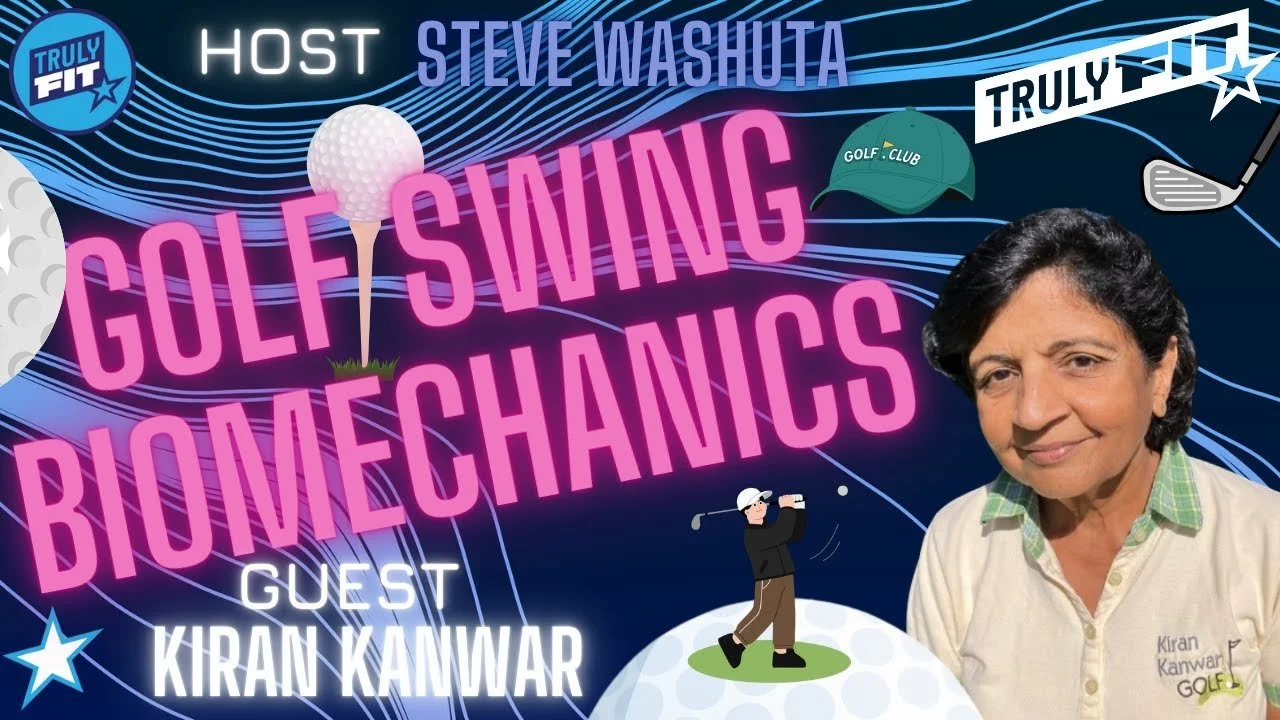
Golf Swing Biomechanics
Guest : Dr. Kiran Kanwar
december 5, 2025
Steve Washuta
Welcome to Trulyfit. Welcome to the Trulyfit podcast, where we interview experts in fitness and health to expand our wisdom and wealth. I'm your host. Steve Washuta, co founder of truly fit and author of fitness business one on one on today's episode I have on Kieran conwar, she has her PhD in kinesiology from Texas Women's University in biomechanics. She has her MS in sports science and nutrition, and and she has decades of experience teaching and researching the golf swing.
Steve Washuta
We talk about everything from what the mechanics are of a golf swing, we try to break that down from, let's say, a layman's perspective, and then we get into some specifics. We go about injuries associated with the common golf swing, and why Kieran thinks we're doing it wrong. She gives her take on what could be done in the golf industry and with golfers to alleviate those injuries in her minimalist swing. And we talk about things like TPI and other studies involved in golf and fitness. It was a fantastic conversation.
Steve Washuta
Kieran has a wealth of knowledge about the body, and in all the best of ways I say this episode, she's a contrarian, just like I am. And what that means is we're not going to just take what is being forced on our throats by the establishment in our respective communities. Mind fitness, hers, more of golf and golf fitness, we try to look at it. Are all the studies that people are posing just correlative or do we have some causal components?
Steve Washuta
Are there other issues that are going on in the background that people are not talking about? And can we fix a problem in a way that other people are not seeing because we're reverse engineering and almost simplifying, right? Hence her minimalist golf swing the process.
Steve Washuta
I really implore you to follow her on her socials, which you can find on her website, your golf guru.com With no further ado, here is Kieran and myself. Kieran, thank you so much for joining the truly fit podcast. Why don't you let my listeners and audience know a little bit more about you, what you on a day to day basis that is involved in the health and fitness and even sports community.
Dr. Kiran Kanwar
Hi, Steve, thank you for having me on basically, I'm a golf instructor with in quote, science pretensions. I have been I've been a golfer for 50 years, which kind of dates me, and then I've been teaching golf for 36 years, and being a mere female, as people would might say, I always was fascinated by hitting the ball further, and I spent a lot of time trying to figure out ways and means. And then I decided I need an education to do that.
Dr. Kiran Kanwar
So by good luck at my mother's prayers, I won the national championship in India, then somebody suggested, Why don't you become a golf teacher? So I did. I came to the US, because in those days, there was nobody that had any sort of education. They just taught by subjectively, by what how they played, or how their students improved, or by whatever they learned from the golf magazines of old. So I came to the US. I came to watch famous teachers teach, David Ledbetter and Hank Haney were very generous with their time.
Dr. Kiran Kanwar
And then I decided this is not enough. I need to go to grad school. Luckily, I had a undergrad degree in physics and math, so I went to grad school. Did a master's from a chiropractic school, Logan University in St Louis, Missouri, and the Masters was in sports science and nutrition. And then I said, Oh, I did every single subject except biomechanics.
Dr. Kiran Kanwar
And it was always understood by everyone in sports that Biomechanics is the thing to study. So I went to a PhD program where they did more research than anyone else in golf. It was called Texas Women's University, and I studied biomechanics there, and then I came full circle and realized it's mostly about anatomy, while there's a little bit of motor control, how the nervous system controls movement and biomechanics that you need to know.
Dr. Kiran Kanwar
But if you're busy measuring moment of a force or calculating your center of mass based on your body segments and things like that, you're missing the big picture, which is to be able to analyze movement and improve it from your perspective, maybe more from an injury point of view, but also obviously from a performance perspective, and then efficiency of the movement.
Steve Washuta
There are a lot of people in the golf industry who claim there is only one swing. Try my swing. Everyone's doing it wrong, right? We have to do it this way. And you know what's what's interesting is, everybody that I work with is a little bit anatomically different, right? There's some variants, right? Are your Is there a ratio between your arms and legs? Is it the way your your femurs are, you know, placed? Is it the, you know, the way your arms hang naturally?
Steve Washuta
There's so much talked about in golf from like, an anatomical perspective. What I would say from like, a static look and a static fitting perspective. Can we take anything out of that without looking at somebody's swing preferences and their age or anything? Can you actually just. Analyze the body and say, well, you're probably not best suited to do A or B and better doing X or Y or Z.
Dr. Kiran Kanwar
So what I've done is a slightly different approach. I start with reverse engineering. What you want at impact, okay? So I look at what do you want the ball to do, and then, based on that, how should the club be delivered to the ball to perform as it needs to perform? Where should your arms be to deliver the club? And why should your body and arms be at the top of your backswing to deliver the correct downswing that you need?
Dr. Kiran Kanwar
But from what you're asking, you basically need to understand that whatever our difference is, you may be a tall male, I may be a short female, I'm much older, you're younger. What do we have in common? The one thing that we all have in common is the way our joints are designed to move, not their range of movement, which will be certainly different, but their joint movement capabilities. What do I mean?
Dr. Kiran Kanwar
For example, your elbow is mainly designed to flex and extend on the sagittal plane. If you give it too much of a valgus or various position, then you're stretching the ligaments and you get injured. So your and and, or what I also believe is that performance and injury are two sides of the same coin.
Dr. Kiran Kanwar
If you position joints correctly at every stage of your movement, then you are able to get good performance, because they are they are able to be in the flow, especially if they're in the same kinetic chain, like the whole arm. If you miss position your elbow, that's in the middle of your wrist and your shoulder, then you're asking for trouble, both with respect to injury, and with respect, obviously, to performance, then, because the elbow is unhappy, right there.
Steve Washuta
Can you describe, maybe, pretend you're talking to a nine year old who's never golfed before. Can you describe what we're doing in the golf swing from an anatomical perspective, from a motion perspective, you know, I know we're working through the transverse plane, but like you just mentioned, it's not just what the torso is doing, right? There's so many other joints and things going on. How do you describe it to somebody who maybe is, let's say, a personal trainer, but they're not a golfer, right?
Dr. Kiran Kanwar
That's a very good question. So I would say, basically, you're hitting a ball on the ground with the club. You're moving your arms away from the ball and then towards the ball in the downswing, and then you finish to decelerate the movement. Right now, which body parts should you move? Should you move? Your pelvis, your feet are stuck on the ground, your arms are free to move, and your torso can move.
Dr. Kiran Kanwar
To some extent. It's a heavy, slow moving part of the body. So the question is, which body parts should you move, and how should you move them? Now, if you look back to the history of golf, five, 600 years ago, the shepherds of God Scotland still made a swing and made some movement of the ball, right? We don't know if they made the perfect movement that they could make, but they somehow did it. So they made some movement of the arms and the body, going back and coming through.
Dr. Kiran Kanwar
And somehow they connected by practice and repeating themselves. If the question is that you want to do it to the best of your ability, then you really need to position the body in certain places based on the torso capabilities, meaning from your pelvis to your shoulders, your head. People don't often talk about is also an important part to be positioned and moved correctly, and then your arms. And then you have to know that you need to use external forces, like the ground, and you need to make the most of the muscles that can give you the power that you need is that simple enough.
Steve Washuta
That's That's simple enough, right? We describe that. Now we'll take this to the next step, right, and be maybe a little bit we'll dive in even further, is that there is power in this movement, right? Ultimately, people who don't know the game, when you're using shorter clubs, when you're in approach shots, using a 50 degree wedge from 80 yards out, there's not a lot of power in the movement. It's likely to not be putting too much pressure on you, from an anatomical perspective, whether that's your lumbar region or otherwise.
Steve Washuta
But as we go up in clubs, when you're trying to hit a driver 290 yards, not only are you swinging it faster, the club is longer, and the movement then becomes larger right, both the backswing and the follow through. And there's more going on. So inevitably, you know, injuries do happen, and it seems to be injuries in the same spots, right? It's not like a lot of golfers have turf toe. It's not a lot of golfers who, you know, who have rotator cuff injuries here and there, but like the same injuries over and over. So what is going on? What do you believe is maybe a thought in the industry that is improper, and how do we fix some of these injuries moving forward?
Dr. Kiran Kanwar
All right, for example, so that is a really important question. I spent a year of my life and looked at 869 research papers to write a literature review for my LPGA master thesis. It's available on my. Site, and for free, I can explain it later, where I looked at every joint in the body, and I looked at the epidemiology of injury of each joint.
Dr. Kiran Kanwar
For example, if you take the low back in any movement, the main injury comes from forward bend, Side Bend, pelvis rotation and then hyper extension of the spine in the follow through. So especially, there is a thing called the you multiply the rotation speed by the side bend, and that is supposed to create even more injury. So can we now work backwards from those injury causing positions and find a way as coaches of the sport and of fitness to avoid those positions,
Steve Washuta
yeah, and that's difficult, though, right? Because most people think you know, especially if you're talking to, let's say, like a TPI professional or somebody being in that side bend position, you get your let's say, you know, if you're a righty and you're leaning towards your right, your external oblique then starts to be contracted, and that keeps your pelvis and your rib cage kind of tightened, which allows you to not go into a forward pelvic position, right, what we call extension in golf. And that's that's a key problem for a lot of amateur golfers is that they push forward into extension.
Dr. Kiran Kanwar
So believe me, there are solutions for most injury problems. So if we're talking golf, I would say the biggest failure in the golf swing is that when you address the ball, when you set up to the ball, if you're right handed, your right side, your shoulder and your waist and your hand is lower simply because you hold the grip lower with the right side Correct.
Dr. Kiran Kanwar
At impact, your right side is lower still. That's just how the swing works. So why did you then, at the top of your backswing, raise your entire right side, shoulder, hip and knee, and lower your trails lead side, which is your left shoulder, hip and knee. Why did you do that? And many will say it's because we have to rotate the shoulders around the forward leaning spine.
Dr. Kiran Kanwar
So I will say why you must first of all ask yourself, which are the muscles that you are trying to harness for force production. If you're trying to harness, to my mind, you're not supposed to rotate. You're just supposed to create a stretch of the muscles you need. You don't need that pelvic rotation, which is another story I can go into in detail.
Dr. Kiran Kanwar
But the main thing is, to my mind, you need the muscles you need are your lats, your pecs, your serratus anterior, because you will inevitably have some protraction. And your external obliques of your right side, if you're right handed, and your internals of the left side right those are all your power producing muscles except for your right side, external rotators of the hip.
Dr. Kiran Kanwar
And I have even done one very basic EMG study where it showed that there was really the glute max of the trail side or the right side did not have any much activation in the downswing with an existing swing, or the minimalist golf swing that I've developed, there was not much, but I saw that there was a lot of activation with the lats, the pecs and the external obliques of the trail side.
Dr. Kiran Kanwar
So really you need to, if you want to make a movement that is safer and gives you as good or better performance, then you really need to understand which are your power muscles, and how can you more move them more effectively.
Dr. Kiran Kanwar
Now, when you talk of your external obliques, for example, in the downswing that because they have to contract and pull your right side down, the external obliques have anterior, I mean, have fibers that are more vertical and that are more horizontal. What's to prevent you from positioning yourself at the top of your backswing to stretch the more horizontal fibers and fire those rather than lifting your entire trail side and having to drop your right side down.
Dr. Kiran Kanwar
You also need to understand the motor control aspect that the brain will always try to use some sort of a tactic or strategy to make it simpler for the body to come down. And the best strategy is gravity, so it wants to really make you come down over the top, or find some way to drop you down so that your lifted upper torso, arms and club can come down to the ball.
Dr. Kiran Kanwar
So there is almost always a way, if you understand the anatomy, the little bit of mechanics that you need to and the little bit of motor control, or how the brain best controls movement, you have to find alternative ways, and I think I found most of them.
Dr. Kiran Kanwar
Again, I reference the paper that's on my website. Most joints. If you keep those joints within their designed ranges of motion, comfortably within those ranges of motion, you don't need to exercise. Death. And, you know, a lot of people don't want to do that. You need to make changes to your swing because it is not always your flexibility and mobility that's the problem.
Dr. Kiran Kanwar
You might need the strength for more power, definitely, but sometimes it could be a restriction of your ligaments or even of your joint structure itself. So fitness is not always the key. You need to marry that with better mechanics. And most research that I've read over all my career of reading research says a thing like poor mechanics, but nobody has ever defined what poor mechanics is, because most don't really know. Have not studied it in depth enough,
Steve Washuta
you did a really good job explaining the musculature. And I would say, you know, from pelvis up, what is going on in the difference between a swing that you would recommend as opposed to the average golfer? Can you explain pelvis down? What is the difference between the amount of power or the percentage of effort I'm putting into my trail leg as opposed to my lead leg in a average golfer swing, as opposed to your version.
Dr. Kiran Kanwar
All right. So one of the big things that we talk about, people in golf talk about a lot, is using the ground. So I'm using the ground with my legs, almost they never are exactly like that, as two pillars against the force of which I'm firing my torso, which which carries all my big muscles of movement, there will inevitably be some pelvic rotation.
Dr. Kiran Kanwar
Whatever there is will happen from facing away from target in the back swing to facing the ball at impact. It will not be that you will open up your torso to face target, which is creating that big pelvic rotation, which is very difficult for your external rotators from the position you are in at the top of the in a typical backswing.
Dr. Kiran Kanwar
So you need to just keep your legs as still as you can, especially not bend that flex that left lead knee, or lift the trail hip. You know, when you have a tilted pelvis, that's the worst thing you can have, because it's difficult to undo. And then people are forcing you. These days, the trend is in golf, have any old back swing and then make the match up.
Dr. Kiran Kanwar
That's a very popular term, make the matchup so you produce correct impact, which, to my mind, is causing all the injury. If you're steep in your backswing, people are telling you just rotate your pelvis more in the down swing. How is the pelvis designed for all that rotation? Because the pelvis is stuck in a closed kinetic chain. Your feet are touching the ground, and you are not able to move those legs so freely unless you kick in, buckle your lead knee into a sort of a valgus position, maybe lift your lead heel and then change your body levels. When you said,
Steve Washuta
Sorry, Karen, I just want to stick on this point for a second. When you said, use your two legs as pillars. Do you almost mean as if I'm keeping equal weight? Let's talk about like percentages, like 50% of my weight on my left leg, 50% of my right leg, and I'm never shifting into the trail leg and then back into the lead leg, and I'm swinging around those pillars.
Dr. Kiran Kanwar
That's a very good question. So with the swing that I've developed, you don't intentionally shift your weight, your center of mass, back at all, but you will have weight shift in the front, because what is center of mass just moving your arms away from your body in the backswing itself moves just enough center of mass that you will have a forward movement.
Dr. Kiran Kanwar
You don't need the whole entire gigantic body to move back and through like you're, you know, on a dance floor, swaying around to the gentle music. And then the other thing is, the rotation is into my mind, more of a stretch of the muscles you plan to contract in a forceful stretch shortening cycle.
Dr. Kiran Kanwar
And the thing that inevitably happens with the swing I've developed, it like caused me a lot of concern, because you're going up and down, but now I realize it's a very popular thing of like jumping up and down, changing levels is considered giving yourself more verticals from the ground, right? You naturally tend because the body has nowhere else to go.
Dr. Kiran Kanwar
You will drop down and push up very naturally. And you certainly don't have to think of any of these things. You just need to be in position where everything you want, your entire wish list of things, happens without thinking. Moreover, it's not just the power with the swing I've developed, you can never, ever if you get it correctly.
Dr. Kiran Kanwar
You can never go left of the fairway, which a lot of the pros do, left of target rather and even right can be easily controlled once you know how to make the movement, and you get very good trajectory, which a lot of women would like, because most women have low trajectory and low less distance. So you can correct all these faults if you just know how to reverse engineer movement from whatever ball flight you desire, rather than going historically. What did the shepherds of Scotland do? And now let's add and mix and match without seeing the basis of whether what I'm doing is actually make sense in science or not.
Steve Washuta
This. Wing is obviously very, you know, esoteric. There's a there's a lot of parts to it. It's always been analyzed from the Kinesiology standpoint and from the mechanic standpoint. We're going to get back to that in a second, but I just want to go backwards and talk a little bit more about injuries. If, if there was, you know, a personal trainer, again, who's working with a golfer, but they're not necessarily golf experts, and their client is coming to them with injuries.
Steve Washuta
What injuries would they potentially be? Maybe this person golfs five times a week and is not associating the golf with these injuries, right? They just think, oh, X hurts, y hurts. I don't know why these things hurt, from a Curran perspective, it is because of the golf, right? But maybe, maybe they're not adding it up. What is going on with somebody who might be overusing particular muscles or in a swing pattern that is causing them injuries? What type of injuries do we expect to see?
Dr. Kiran Kanwar
So again, I keep repeating that my research paper that I spent a year on literally gives you everything you want to know which are the most common joints in males, in females, in professionals, in amateurs. You need to read that to understand now, the typical joints you see would be low back for men and women.
Dr. Kiran Kanwar
You would have, more recently, parent of a junior elite golfer mentioned to me that the girls have more wrists and shoulder and the boys have more low back because they swing more forcefully. And the reason I met this gentleman is because I'm doing one of the rare epidemiology studies in golf, looking at elite junior golfers and seeing how much they get injured.
Dr. Kiran Kanwar
You know, when is injury beginning? So the fitness professional is best advice to look at that paper, which gives you a lot of detail, more detail than most people want. And there are, there are solutions that these are the movements that have to be avoided. Then your fitness professional has to have some basic understanding of the golf swing, understand the Kinesiology of the movement from an anatomical perspective, as well as a little bit of biomechanics, and then figure out how best they can help their student.
Dr. Kiran Kanwar
They must, in fact, be able to harness the muscles specifically that they want to create movement, and They at least need to ask whether the golfer has pain during or the day after the movement, in which case you could ascribe it to the golf swing, and it did not be that the golf swing has caused the movement. It could also be that the move, the golf swing exacerbates the movement, in which case you still need to make changes in both your fitness training and the golf swing. Understand. Look at take a little history of the movement.
Dr. Kiran Kanwar
Look at which other painful positions, you know, try and elicit the pain. These are things that fitness, a person really needs to do. But unfortunately, again, even in fitness, I've done the ACSM personal trainer. When I did my masters, I we studied the CSCs textbook. And now in my university where I teach, I've developed a course based on the NASM course book. So nobody Exactly. They just give you the theory of the different systems in the body. They give you the theory of how the body works.
Dr. Kiran Kanwar
But how should a coach put it together? So when I did this ACSM certification, way back in 2009 I told my son, very proudly, look, I have this ACSM certification. And he, being a young man, wanted to develop his chests and his biceps and his pecs. And, you know, the usual thing, he said, Give me six exercises. I said, I cannot even give you one. I don't know where to begin. I don't do those exercises as a woman who's not interested in developing the chest, and I don't know where to begin. Like, you know, there's, there's a there's a disconnect in the theory that we learn in all these certifications and how a person should go about it.
Steve Washuta
Yeah, don't get me started on that. Kieran, we could be talking here for an hour. I literally wrote a book called What the certifications don't teach you fitness business, 101, because, you know, unfortunately, it was a, it's a money grab for a lot of people, and they do teach you, you know, the basic kinesiology and physiology of the body.
Steve Washuta
But as far as programming and putting things together and goals, it's impossible, because ultimately, you have to work one on one with someone and know their specific goals and their body type and all. And it's, it's very intricate, right? You can't, you can't just have a blanket program for everybody, whether you're a female or a male, or you're 65 or you're 16. It is going to be different. And the only way to do that is is to be thorough and to spend a lot of time one on one. But everybody wants a blanket, easy program. To tell you, this is how you do it. It's not going to work. Same thing in golf.
Dr. Kiran Kanwar
But here's what I want to say. I just finished teaching my first introduction to kinesiology course as a general ed course for undergrad majors, and I was very unhappy I gave them the theory, the raw basics that you really have to know. I mean, I said, don't even know the muscles. If it is a flexion of your knee, and if it's an extension of your knee, is it anterior, posterior to joint, which is the origin, which is the insertion, which way is it pulling?
Dr. Kiran Kanwar
Don't even tell me your name. You know basics. But what I discovered was that I was very unhappy because. I was not getting the link, so I had a very nice chat with my friend Claude, and Claude said, what you've done in golf is the actual blueprint that you need for any movement analysis, which is how to reverse engineer it you figure out the goal.
Dr. Kiran Kanwar
Say you're doing. Say, for example, I did a baseball pitching internship at the famous American Sports Medicine Institute, and there you keep hearing of Tommy John. Tommy John Alda, collateral ligament injury of your throwing arm. But is there no other solution? How much fitness can you make of that elbow? The ligament is basically what's staring.
Dr. Kiran Kanwar
How much strain can that ligament take? Is there a better way to make the movement that will give you the speed you need without putting that elbow into so much valgus right in my class that I just finished say, for example, you do a standing broad jump. So I would, because most of my students were student athletes, so they would come up in front. We had a big space for them to move about. I said, Okay, make the standing long jump for maximum horizontal distance, which is the goal, right? I said, All right.
Dr. Kiran Kanwar
Now, make the standing broad jump for maximum height, and you could see the difference. I had two athletes, one went far and one went high. Then these were very top basketball players, so they really could demonstrate this. Now, I said, we have to figure out, what's the difference in the movement, you know? And that's how you begin to figure out. You make different movements. And you figure out yourself. You try it on yourself first, because you cannot try it on a patient or a client or fitness client.
Dr. Kiran Kanwar
So you try it on yourself and see is this? If this is the goal of the movement, this is what I need to be doing different you and there is a way, by simply reverse engineering, you know, your goal, and you work backwards from the goal, where should my body be? Where are my power sources? Where are my injury issues? If you're doing a cut in soccer, girls playing soccer, and they get ACL, they cannot take so much, you know, kicking off the knee.
Dr. Kiran Kanwar
So you have to be careful of these things. So now I've realized, and I'm going to work on this, I'm going to make a course soon that will help golf coaches, fitness coaches, any sports coaches, to work backwards from what the theory is, which you have to know to to a good extent to make the analysis, but how to make a good kinesiological analysis for any movement?
Steve Washuta
What are your thoughts on TPI, either as a whole, or maybe there's an individual process or technique or concept that you've heard of that they promote, that you either think is fantastic or that you disagree with.
Dr. Kiran Kanwar
So first I would like to say about DPI that they have the most phenomenal board. If you look at the list or the board of all the different experts, the surgeons and the fitness people and all those people, they are phenomenal. You couldn't get a better list of people. They have somehow picked up bits and pieces from the industry, like how to use ground reaction forces and things like that.
Dr. Kiran Kanwar
And their main belief is, you look at the body and you understand what the issues are with the body, and then you fix those issues so that they can make the swing. They say, you can have any swing, but your body needs to be able to make it. And I say, No, your body is not designed to make any swing. Your human body was not designed for golf. For instance, it was designed to be hunter gatherer, run and catch your prey, or throw a spear at some creature, or pick fruit from trees, right?
Dr. Kiran Kanwar
So it was not designed for all this rotation and jumping and kicking and stuff that people are doing so and the other thing is they have correlated their basic screen that they use for the level one with certain swing falls. Are those swing falls because of some misperception of what the golfer understood like. If you tell me to shift weight, and I shift too much weight and have what they call a sway, you cannot immediately understand from it that I have some physical limitation, right?
Dr. Kiran Kanwar
So they would really do well to open up their mind to more ideas about what swing ideas work and marry the two, because they have some fabulous power stuff, and which are very general. Again, they say the vertical jump is highly correlated with with more with a more powerful impact and better ball speed. Yeah, so fine, it's correlated. But is that vertical jump necessary and sufficient for creating speed? No, it's not. You know, I could produce a lot of speed with the swing I've developed with being able to do a six inch vertical jump. Okay, so, yeah, there's lots of reasons why things happen,
Steve Washuta
and sorry, just to, just to stay on that point for a second here, because I think it's really important to, sort of, you know, pound this through. You'll see a lot of these younger golfers who go to a TPI studio, and they're showing their force plate production and how it's through the roof. And, yeah, the. He's a he's the furthest driver on the tour.
Steve Washuta
Well, guess what? Phil Mickelson was also driving 300 yards, and I don't think you know, at the age of 39 he couldn't jump three inches, right? So the fact that it works for some guys and not other guys should tell you that that's not the reason, right? That that is the reason for that individual golfer swing, but that isn't the reason that can translate to every other golfer swing
Dr. Kiran Kanwar
exactly, 100% I agree with that, because everybody, to some extent, is different, and it is not the cause. The main thing is, all they have, not they other people have studied their the test, the assessment that they do to correlate with the swing fault. Now, if you're doing an assessment, it has to exactly, not even just correlate, but there should be a causation to imply that your Sway, that your fitness limitation, is correlated to a swing fault.
Dr. Kiran Kanwar
But there are only about three of them that are actually correlated. The other tests are just like fine, and there are no actual solutions being offered. Swing wise, all you're being told is to improve your stability, mobility, and then your strength and your power. So is that sorting out your problem?
Steve Washuta
No, certainly not. Yeah. I mean, it's, honestly, it's quite the cop out, right? To to point out. I mean, imagine you did that in any other area of life, right? You point out a fault. Imagine your financial advisor is like, hey, look, this is all going wrong. You're spending too much money in this area. You don't have enough money in your checking account. I checking account.
Steve Washuta
The fix is put more money in your checking account. It's like, well, no, what? You can't just tell me that the power is the solution, right? What are the actual things that I need to be doing? And then also, why are why does it work for some people and not for other people? Like we just talked about, it just doesn't get talked about enough that we have 40 year old golfers who are not very strong, or we have even the Ricky Fowler's of the world. Ricky Fowler is like five, eight, 155 pounds, right?
Steve Washuta
And he can, he can hit his four iron just as far as anybody else in the PGA Tour who's 642, 100 pounds. So you know, why is this? He's, there's no way he's creating the same amount of ground force production as a Brooks koepka or some of these bigger guys, a Dustin Johnson, but he's still able to do it.
Steve Washuta
And I do think, you know, we need to look at that, but, but, but that might actually so let's come back to that. Is there a difference in analyzing these professional golfers that we're talking about and the average golfer, and is your swing, the one that you're promoting, and the things that you're promoting in the swing style more suited to the amateur golfer than it is to the professional? Or can it work on all levels?
Dr. Kiran Kanwar
So my question to you is, do the amateurs and the professionals have the same joints that work through the same planes of motion?
Steve Washuta
They certainly do. So that
Dr. Kiran Kanwar
answers your question, if
Steve Washuta
they're human, but here would be my slight pushback, is that the professionals can risk more of their joints because of the risk reward. So if the reward is higher, they can risk these injuries because they have the chance to get their PGA Tour card. Where, Steve, I don't want to get injured because I'm a 16 handicap. I'm not, you know, I'm not worried, like I just want to get out there and play.
Steve Washuta
But if you're getting that much more production out of these swings that are more back intensive the tiger swings, right? Is it? Is it worth it for some of these guys to get injured? Are you saying no, under no circumstances, it's not worth the injury risk, because the difference in the level of production that you can get from your swing and their swing is so small, or is it, is there no difference? No.
Dr. Kiran Kanwar
So here's what I would say. I can guarantee you that you will be dead straight, which none of the pros are under pressure. Their swings fail because it's very timing dependent. I can reduce your risk of injury because I don't use those massive ranges of movements, especially of joints that are not designed to have them.
Dr. Kiran Kanwar
And I can guarantee you as much or more distance with excellent trajectories, much better sometimes. So what do you want? You want to take a risk. Go ahead. You can kill yourself. You will never get back. Because Look at poor Justin Thomas just a few weeks ago. Look at Tiger. Look at who's at his seventh back, low back. So was it worth the risk to them? How many will Zala Torres will zalatari said, 26 had to lay off.
Dr. Kiran Kanwar
will never catch up with the rest of the guys. Because when do you make up for all the practice they are going way ahead of you. When do you make up for the practice? Are those joints now capable of the same movement? Do you dare to move them through the same range of movement? You see, these are all the concerns. Are you? Yeah, you can be 16 and say, I can do what I like if I stop playing golf by the time I'm 25 I've made all my money. Fine. Try it. You don't know that there is not a better solution for you
Steve Washuta
is the single plane swing that was, you know, that's been made famous by Mo Norman. Is that similar to your swing? How would you describe the differences between the MO Norman single plane swing and the Kieran conwer swing?
Dr. Kiran Kanwar
So, you know, I get asked that all the time, but there are some very good things to mo Norman that he never moved that left arm. Am much, but there are a lot of things that are not anatomically sensible. Like, for example, at the he could do it, as you're always saying, individual, he could do it, but I don't know how many others can do it at the top of his backswing, you like, for example, I must go back a little bit. TPI is always talking of the 9090, test to see your external rotation, right?
Dr. Kiran Kanwar
But, and when you are in a golf posture, that external rotation reduces, which nobody has looked at, is that when your hands are both on the grip in a closed kinetic chain, it and especially when you're dropping your whole lead side, that will reduce even more. You are not going to get external rotation from the movement.
Dr. Kiran Kanwar
So at least get your trail side shoulder retracted as much as possible, which they are not able to do when you drop your lead side and you lift your trail side unless you push. I now use the arms to push the to get the trail shoulder into maximal retraction. When you are in maximal retraction, you will have less internal rotation, not none, but less, and you have enough room to come from the inside and not come over the top for any level of golfer,
Steve Washuta
I guess my question is, seeing this in my mind with a wood it seems Very simple to me, right? I can see the swing. I've actually I've watched your swing. I can put this all together, anatomically speaking, and look at it. When there's not a lot of loft on a club, it seems very simple. When there is a lot of loft on a club, it seems more difficult, right? Because now the positioning am I? Am I do? I need to cup that lead hand. What am I doing to get into the same position with a 60 degree wedge that I am a three wood in your swing?
Dr. Kiran Kanwar
The difference is only the length of the club, how far you stand away from it. The movement is the same. I want the ball position to be centered, which is like people are going to faint in shock when I say that, because I'm trying to push you back into a maximal trail shoulder retraction. If the more forward your hands, the less you're likely to be able to retract.
Dr. Kiran Kanwar
And there is no research proof that a forward Ball position is essential. And even for the driver, I can get you plenty of launch angle, even without having that forward when you have the more forward ball position, in fact, you have to side bend or laterally flex a lot more to get the club on an upward angle to impact. There are
Steve Washuta
simple would there be a lot of, sorry, would there be a lot of forward shaft lean to also start the swing?
Dr. Kiran Kanwar
No shaft is centered. Okay? Everything is very basic. You don't have to look at over the top. You don't I mean, you don't have to look at across the line and laid off. You don't have to the wrist will automatically get into position. You don't have to look at the grip, because by the time your takeaway is over, you will get into the position of the wrist. By what I have you do, you don't need to worry about whether you're weak or strong or whatever in your grip. Most things are taken care of by the way you start your backswing. The takeaway,
Steve Washuta
does anybody who is of any measure of fame or fortune use your swing in some respects, even if it's not something that maybe you have taught them right, or they learn from you, or they're doing because they think it's anatomically better, they just fell into that. Is there anybody who does any of those movements that you talk about just naturally?
Dr. Kiran Kanwar
So long drive guys? Actually, I would say the person who swing I consider is the simplest and easiest for somebody like me to convert, would be the President's swing. Forget the big loop that he makes. But really, swing is very basic. He takes his arms back, and he doesn't move his torso much. And I think if we were ever amenable to it, I could change his swing in 10 minutes, because, you know, he really has a very basic, simple movement, maybe because of his body type or whatever. But other than that,
Steve Washuta
if you get him as a client, I'm sure, you know, would be set off. Yeah, you know, you know who I was thinking of. You know, I asked that, you know, the most accurate driver of the ball of all time, especially a single season, was a guy named Calvin Pete.
Steve Washuta
And Calvin Pete didn't move his left shoulder off his off his body, his lead shoulder off his body at all, because he actually had an injury as a young boy that I don't know. I don't know if it was necessarily what the injury was, but it caused him, whether it was post surgery or just the injury in and of itself, with scar tissue, he wasn't able to lift his arm up laterally, and he kept it connected, and the most accurate driver of the ball in any PGA season of all time.
Dr. Kiran Kanwar
But I'm not talking of arms being connected. I'm talking of body being stable and arms being as free as a butterfly, because you have to get your movement from somewhere. You see most of your big movers are connecting the torso to the arm. You need to stretch them in your backswing. Yes, and it sounds very static when you describe it, but there is ample motion when you look.
Dr. Kiran Kanwar
Cut a swing, especially my recent ones. In the past, I used to have golfers rotate the entire torso and never bothered about the arms, which went very steep and then didn't do anything. Right now, I use the arms just as of a year ago, are you have you used your arms to position the torso where I want you to
Steve Washuta
if I'm looking at you, if I'm looking at your swing and I'm zoomed in, right? So I have a zoom in I'm looking at your swing and someone else's swing, and I'm just looking at the shoulders. Can you describe the difference, if you just if you're zoomed in on your swing, what's going on in the shoulders versus the average swing?
Dr. Kiran Kanwar
All right? So they would look the same until you look down at the pelvis, what is doing? My shoulders would be like 90 degrees backing the target line, okay, but how I get there is very different, and how they are being moved is very different. And that shoulders, most importantly, are level. If I have even a little bit of an inch or so of Rise of the right shoulder, it is going to be an over the top move, because that is the simplest default for your motor control system to use.
Dr. Kiran Kanwar
To my mind, the over the top movement is your natural selected movement, which is straight down to the ball. It's very easy for the brain you use gravity, and it's easy to reroute by dropping your raised torso backwards, and then come from the inside, like Rory McIlroy, for instance, does means that he has to make a big thrust out of his arms towards impact, which he was recently explaining to Tiger Woods.
Dr. Kiran Kanwar
He's found some solution for that, but I wonder how easily that will work. He basically has so much side, shift, backward, shift, movement of the torso, then he has to sink his arms with the torso, which is not an easy job here, because you're just using your arms to move your torso. It's synced from A to Z, kind of a thing.
Steve Washuta
You know? What's with this reminds me of a lot of what you're talking about is something that I focus on in the fitness industry, Kieran, and that is your goal. Typically should be, anyway, in fitness, long term health and wellness. And you know, you work out at 16, and the 16 year old has the same goals as your son did. Can I get bigger pecs? You know, can I have, can I have bigger biceps? Right? They're not thinking down the road.
Steve Washuta
I understand that. But eventually, whether it's an injury or whether it's a mentor, it does get ingrained into their head to say you're going to be doing this, hopefully, until the end of time here, and you have to make sure that you're working out in a smart manner, so that you can be working out to the end of time.
Steve Washuta
And that's the same thing with golf. Is that when you're learning to swing it, some kids at four years old, it's six years old, 16, whenever it is, and your body can do basically anything to avoid injury, just because you're younger, you're more mobile, you're more flexible, you recover faster, right? You're not thinking about down the road.
Steve Washuta
But ultimately, golf is the sport that everyone plays the longest, right? You're not playing tackle football. At 76 you'll have no problem playing golf 76 so I think it is important to start to develop swing patterns that you can use for the entirety of your life and perfect that, because what's going to happen is, at some point, at 50, when you get these injuries, you're going to have to learn a whole new swing pattern.
Steve Washuta
So wouldn't you want to have just ingrained this into yourself when you're younger? That's what I try to tell people in the fitness world, is that, yeah, you're doing these, you know, 350 pound deadlifts, but when you're older, and mobility and flexibility are more important, and you're not going to recover the same way. These are not the exercises you're going to be doing. You're not going to be moving in one plane of motion with heavy weights.
Steve Washuta
You're going to want to use light weights and move in all planes of motion. So start doing that younger. So you ingrain those patterns into your system. And I think that's really the pitch for your swing is, hey, I know you guys might not have injuries now, but it's inevitable. You don't have them at 16. You're going to have them at 16. Them at 60. Avoid them.
Dr. Kiran Kanwar
That's a very good point. Like poor JT has been making this swing forever. How do you know that you're not the one that's going to be caught in the trap of injury? There are so many factors affecting your injury.
Dr. Kiran Kanwar
And one more thing I wanted to say about the fitness world, when youngsters develop their pecs and their you know, chests and the biceps, all of them are now because of the careers being in computer based, things rounded and you have a forward head. You're texting all the time, and all this is not only going to affect your golf swing, but affect your life in every possible way.
Dr. Kiran Kanwar
So, yes, you have to when you start young, but the person training you, or the person advising you needs the education to know all this, unless you've gone down the road of how to train a young person better, how would you know where to begin?
Dr. Kiran Kanwar
You have to keep it more reps and lighter, you know, and not overdo until and why do you do so much strength like the 300 pound deadlift? For what purpose, except to look look strong and look Macho. Is it helping you in any way? Why don't you stay in the strength and endurance spectrum rather than go into the, you know, the hypertrophy and the excessive lifting?
Steve Washuta
Reason for it? Yeah, I mean, you're preaching to the choir. I mean, that's, I think, Paul. Part of the reason is there is an exhilaration from it, right? So, you Yes, these people, they hop on the bench press, and, you know, their goal is to get whatever it is, 300 pounds, and they get it for the first time. And there's an exhilaration you get physiologically, from meeting these one rep, two rep goals.
Steve Washuta
Yes, you don't otherwise get from sitting down on a machine and doing, you know, just eight, eight presses. So there is a, there's a, there's a psychological thrill to this that I that is imbued in it. But I think, you know, another part of this, this problem here, is that if strength and power is something you want, you can actually get that later on in life. We've proven that.
Steve Washuta
We've we've seen that. I know, I know 50 year olds who are stronger at 50 than they were at 25 you know what? I don't know. Kieran, I don't know 50 year olds who are faster than they were at 25 right? So or So speed is something that goes away from you. So I always tell people, you want to, you want to keep those up, right? You want to fire those neurons faster, keep the movements work faster, but work safer, because that's what, that's what you lose.
Steve Washuta
That's really hard to build back up. We can get strong. Strong is easy, but, you know, it's, it's it comes with the times too. There's a, there's a cultural aspect to how you look at any given time, right in the in the 80s, yeah, what we saw, what we saw in the magazines, was different than what we see in the 90s. And then we had the runway models, and now people are back to a different body style. So it'll change back eventually, I'm sure, culturally speaking,
Dr. Kiran Kanwar
but, but you know, people are living so much longer as the as the research shows, the person who will live to 150 has already been born, right? So given that people are living longer, I teach a course in perspectives in aging and health. So all these are young students coming to me, they look so bored, like they're going to fall asleep at any minute. I say, Listen, you guys, listen up.
Dr. Kiran Kanwar
The if there's one thing that's inevitable in life is that that will happen to every one of us is that we will age. You will either age successfully or unsuccessfully, and to age successfully, you have to deposit money in your bank right now so you can pull out your savings when you're old and don't work anymore.
Steve Washuta
Yeah, I couldn't agree more. I always use the same monetary analogy. I tell people, when you're young, it's okay to be a little bit more, let's say 8020, stock to bond heavy in the market, right? You take your financial advisor says, take some risks. You have the money. And then as you get older, you have to be risk adverse, right? Yeah, that stock to bond ratio tends to switch because you have to go into retirement.
Steve Washuta
That's the same thing with your body, right? You can do you can be a little bit riskier. Build that muscle at an early age, but at some point, you need to have that aha moment where, unfortunately, it usually happens when people get injured, right? They have to suffer through an injury, including yours truly, until you get to the point where you go, you know what? I might not be able to handle the next injury, right? I got over this one. So let me, let me, let me fix my training style. And that's what you're trying to do, obviously, with the golf swing.
Dr. Kiran Kanwar
Yes, exactly. And then it's like a case of delayed gratification. Few humans are capable of delaying the gratification of looking good and, you know, getting the dopamine high and whatever. So it's difficult to preach to people who are not converted already.
Steve Washuta
There was a great book The name EVAs me exactly something the other 80% or something to that extent. And it was about this guy who did this longitudinal study on, I think it was LPGA golfers, actually, and that there were a much larger percentage of professionals that were cross eyed dominant, meaning that they were right eye dominant.
Steve Washuta
They were left handed, left eye dominant, right handed, as opposed to the average person who like me, I'm right eye dominant, right handed. And they were showing that these golfers seemed, there seemed to be something to that right if that eye is fixated on that ball that is your lead eye. It's much different. Do you have you heard of this before? Do you lend any credence to it?
Dr. Kiran Kanwar
So I heard of it. When you asked me about it, I would say that there are three levels of sensory perception, visual and then vestibular, which is in your inner ear, which feels the balance of your head and neck, and the most important is your proprioception of the of in your muscles and your joint. Every joint is telling your brain where you are in space.
Dr. Kiran Kanwar
And even if you close your eyes, you still feel it. So your most important feedback system is vestibular, and that is giving you the feedback of where you are, right. So how much the eye dominance helps? I don't know. How many people did he study? The person who's done this is the first question I would ask. Is he able to generalize to all people, and those people like for me, for example, I'm cross dominant. I'm right handed, very much right handed, but my left eye is dominant. Why did I not become a tour player? There are many other factors, right?
Steve Washuta
Well, you're pretty good, though you're pretty good. No,
Dr. Kiran Kanwar
I'm just literally average, and I've made the most of it by understanding by understanding the science, by making a study out of it, rather than having some great physical attributes, right? So there are so many factors, unless. To prove a causation, which is very difficult to do. It's merely a correlation. And I think from the synopsis I've read, I cannot say for sure that these people move differently, but in which manner do they move differently?
Dr. Kiran Kanwar
You have to quantify which aspects are they move. I will tell you one thing. In the few left handed people that I've taught over the years, I find that they naturally tend to swing more flat. Now I will not say that all left handed people tend to swing flat, because I'm not taught enough, and I'm not sure I haven't done any study, but this is a feeling even their putting stroke will be like a rotary sort of flat thing. So I would not make a claim from that, because I certainly have no idea.
Steve Washuta
Yeah, I think the way you would do that is simply take a bunch of people at a young age, four and five year olds, right? Find out if they're right eye or left eye dominant, and then teach them how to play golf both ways, right? Make them equally every day, like if you're you know if you're going out and hitting 1010, seven irons with your on your right hand, and then hit 10 sevens with your left right and see if there does become again, you might just say this is a correlation, but eventually, if the numbers, if the numbers are enough, it seems to be causal, right?
Steve Washuta
So if, if we found out that 87% of these people who were ex dominant turned out to be better with one hand, it would lead you to believe, if we controlled for other variables, that you can find that out. But they didn't do that, like you said, it's not they're looking after the fact rather than looking prior to the study.
Dr. Kiran Kanwar
But to also control the variables is very difficult, because, say, I have some restrictions on my left side, and I try to swing like a left handed golfer, my swing is not going to be the same for other reasons than even if you train me identically for both left and right, which is also doubtful. How does my brain perceive it differently? You know, the difference is from many things other than your visual dominance, to my mind and some questions are too complex to ever answer, even with a even with AI that we have these days,
Steve Washuta
I like it. You listen. You your thinking pattern is in the best of ways, Kieran contrarian and and I think I say that as as a compliment, because so is mine, because I you need things to be laid out and proven. You're not just going to believe it because of some sort of, you know, again, relationship. That's not causal, but that's correlative, because that's all we see now.
Steve Washuta
And it's really easy to see some high correlative relation and fall in love with that theory and keep chasing it, and only start to see things that add to your theory instead of things that take away, because you're so dyed in the wool, and that's what I see happening a lot in the industry, and
Dr. Kiran Kanwar
you have such a strong cognitive bias in that
Steve Washuta
with that idea, there is a this. This is a, an interesting thing that happens in Canada is that a lot of you know, Canada is primarily a hockey country, obviously, right? They're the best hockey players in the world, and that's, that's that is their sport. And in hockey, shooting is not as important as stick handling, right. It doesn't matter.
Steve Washuta
You'll never be able to score a goal if you can't actually get the puck on your stick right. So stick handling is more important than shooting, and because most people are righty, it's better for them to have their lead hand in front. So essentially, what that means is, in Canada, most people shoot in America what we would call lefty because the stick handling is easier with that lead hand in front, if that makes sense, right?
Dr. Kiran Kanwar
Lower down. Do you mean lower down on the stick? Well,
Steve Washuta
so basically, think of a lefty golf club, right? So in a lefty golf club, your your right hand is your right palm is supinated down right, and you're and you're gripping, you're gripping tight, and the left hand is just guiding a little bit, but the right hand is really moving around.
Steve Washuta
So, so, so the righties actually learn hockey lefty, because the right hand is, what is you like, being used on the stick for stick control. So, so in Canada, they sell like, basically, like almost 6040 golf clubs, Lefty to righty, because they learn how to play hockey in that manner, because the stick handling is so important, and then it just becomes more natural for them to be standing in that position with their right leg being in front.
Steve Washuta
So I just, I always found that interesting, that in Canada, you know, it's 5050, 6040, whatever. In America, it's what, 9010, or, you know, 8515 right handed to left handed golf club. So if you're ever looking for left handed golf clubs, you know, buy them from Canada. There's a lot more of them.
Dr. Kiran Kanwar
I like that. Yeah. It's nice to try out new ideas and see if they work. Yeah. And I think that's the only way forward to progress in any sport. You need to understand the design of the body and the mechanics and then try out ideas that make sense within that those parameters.
Steve Washuta
This has been great information. Let my listeners know where they can find more about you. Certainly the research paper that. Be alluded to twice if they want to reach out to you directly for questions, your social medias, wherever you want to point them to that's important.
Dr. Kiran Kanwar
All right, so my website is your golf guru, g u r, u y o, u R, G, o, l, F, G, u r, u.com and you can put forward slash lessons. If you want my lesson page, you can just go to the contact button there if you want to get in touch, if you scroll right down to the bottom of the home page, there's a button that says, under research, LPGA, Master, thesis, and it's 116 page document, but it's really very informative to anyone wanting to understand injury, specifically for golf, but also for any the biomechanics is the same.
Dr. Kiran Kanwar
How you get injured, the different tissue gets injured is exactly the same. Then on Instagram and Facebook and LinkedIn, I'm basically Kiran kanva or Kiran kanva Golf. They're similar. They've been made at different times, so they don't all exactly match.
Dr. Kiran Kanwar
You can look me up by my name, and in YouTube, it's the minimalist golf swing system, system, meaning for full swing and short game, again, the short game I've designed so that it suits the design of your body that I do some fun research with my beginner golf classes at the university Stanton University, where I teach, and we are seeing that there's a difference between the minimalist golf swing and the typical golf movement that people use for full swing and short game.
Steve Washuta
I will put all the links in the description from the socials to the website to the direct to the paper. My guest today has been Kieran Kanwar. Thank you so much for joining the truly fifth podcast.
Dr. Kiran Kanwar
Thank you so much for having me, Steve. It was wonderful, very exciting to chat with you.
Steve Washuta
Thanks for joining us on The Trulyfit podcast. Please subscribe, rate and review on your listening platform, and feel free to email us. We'd love to hear from you social@trulyfit.app. Thanks again.

Dr. Kiran Kanwar
Website : www.yourgolfguru.com/lessons
Instagram : @kirankanwargolf